Tuesday, June 22, 2010

Team USA at Checkpoint Charlie Beach

One of the highlights of this trip has been watching the World Cup at Checkpoint Charlie beach, with makeshift sand and beach chairs in front of a giant HD screen in the heart of the former East Berlin. Below is radio reporter Matthew Katz relaxing with mad hatter Faryl Ury of APTV and Anna Rhett Miller from CNN.Thanks to Michael Lipin, a reporter for Voice of America, we had plenty of USA swag for the crucial match between USA and Slovenia. I confess to divided loyalties here, as the Anzur family is from a small town near the Slovenian capital of Lublijana. A weird referee call robbed the USA of its winning goal and the Yanks had to settle for a tie. My son Andrew is joining me in Berlin for a few days on a break from his summer internship with the US Commercial service at the Embassy in Bucharest Romania. He made things interesting by cheering loudly in various slavic languages for Slovenia, along with NPR reporter Jack Zahora, who speaks Czech, Polish and German.
We've enjoyed several matches and a lot of beverages at this venue. Of course, they show Germany's number-one news program, the Tageshau, at 8 pm.
Even when the USA isn't playing, we enjoy watching others cheer for their favorites. We felt sorry for the lone South African fan who tooted his vuvzela in vain as his team was defeated. I've enjoyed getting to know Jo Dondis, a freelance TV producer from LA, as well as all of the other RIAS fellows, as we relax together and watch the games.

Government Transparency

One of the most popular attractions in Berlin is the clear dome over the Parliament building. It was known as the Reichstag when it burned down in 1933 under mysterious circumstances that allowed the Nazis to come to power by blaming Communists for the fire. At the end of World War II it was liberated by Russian troops and the brilliant restoration of the building allows visitors to see the graffiti the solders wrote on the walls.
Our RIAS group got the VIP treatment and didn't have to wait in the two-hour line for the elevator to the dome, which symbolizes transparency in government. All political parties can agree here that the views of Berlin are spectacular!The government complex in Berlin has grown considerably since I was first here in 2001. We met with representatives of the five major parties in a building that looked like a futuristic Star Trek movie set.

Party Lines

We attended a plenary session of the German Bundestag, or lower house of parliament, on a day of special debate on education, so the chamber was relatively empty. The TV cameraman in the gallery had the world cup soccer match on his viewfinder. The real drama came in a series of meetings with representatives of all five major parties. The "links" or left party represents what remains of the former East German communists, convinced that the glorious productivity of the German worker will lift the eurozone out of its crisis without any cuts in social welfare benefits. I was so caught up in the Green's "New Deal" for the economy and the environment that I forgot to take a picture of their representative. He asked about climate change issues in the US seemed quite shocked when I explained that many Californians don't like recent environmental legislation that could put more than a million people out of work.
I wish the US had a viable party like the "liberal democrats," who aren't liberals or democrats at all. They favor low taxes and small government, but libertarian when it comes to individual choices on social issues. They are the kingmaker party at the center. They believe in tax cuts to stimulate business growth, but since they can't deliver they are losing support and fighting with the majority CDU party.
The majority Christian Democrats, the party of Chancellor Angela Merkel, are taking a lot of heat for their Germany austerity program and bailout of Greece. It didn't help matters when the German president, largely a ceremonial job, quit unexpectedly because his feelings were hurt after the press criticized his comment that German troops should protect the country's economic interests. This sets up a vote on a new president that is seen as a test of Merkel's popularity.
Finally, the SDU, or Social Democrats, lost a third of their support in 2009 after 11 years of running the government. They are hoping to capitalize on the CDU's problems but aren't offering much in the way of specific alternatives.
Outside the parliament, we also met with a union representative who talked frankly about unification issues with former communist workers from East Germany. All the factions agree that more regulation of the banking industry is needed, and stimulus spending is out of the question. But no one likes to see their favorite programs cut. Clearly, there is more room for compromise in a coalition system and the politics are not as polarized as in the US.
We also had an enlightening "off the record" lunch discussion with one of the leading MPs in the Merkel coalition government. He worked the room as if campaigning for our votes and never missed a beat while downing a substantial chicken entree for lunch. Impressive! He talked frankly about German disenchantment with President Obama and the difficulties the CDU is facing because of the eurozone economic crisis. He seemed confident that other countries in the EU who have not yet adopted the euro, such as Poland, will eagerly do so as soon as they are qualified. I'm not so sure.

Hitler's Parking Lot

A weird and oddly popular tourist attraction is the site of Hitler's former bunker, where he committed suicide as allied troops moved into Berlin. Until recently there was no marker because Germans feared the spot would become a neo-Nazi shrine. Instead, there's a steady stream of curious tourists. It is now a parking lot for an apartment house, and only about a block from the monument to the murdered Jews of Euope.
Germans constantly apologize for Nazi atrocities as part of their normal conversation. Consider this sign outside a West German subway station, listing concentration camps as "destinations we never want to visit again." The legacy of the former East Germany is more difficult to cope with, as Germans who once spied on each other continue to live side by side.

Working in German TV

Imagine if PBS in the United States had a huge budget, a huge audience and could put those resources into covering the serious issues of the day. They have that luxury at Germany's "first channel," ARD. Eight million people stop what they are doing at 8 pm each day to watch the Tageshau, a 15 minute roundup of the days top stories, read by a rotating cast of presenters so that the news, not the anchor, is the star. They don't even use a teleprompter, which gives the show even more of a time-capsule feeling. We met with representatives of ARD's radio, TV and online divisions, although there is a reluctance to devote resources to the relatively new web site and social media. The studio in Berlin deals almost exclusively with politics and the actual headquarters are in Hamburg.

Another perspective came from Brent Goff, an American who anchors a business show in English on Deutsche Welle, Germany's equivalent of the Voice of America. You can watch their news programs on a lot of cable systems in the US. Brent has enviable working conditions: two weeks on, two weeks off, six weeks of vacation and plenty of time to get extra pay by moderating business conferences, teaching at a local university and moonlighting for other stations. This discussion degenerated into the shortcomings of US media, including Barbie doll anchors and pre-conceived notions by editors who only want stories from Germany about neo-Nazis, the Holocaust and beer. Brent is clearly enjoying life in Berlin with his partner and made sure we knew where to find a competition to pick the city's prettiest Drag Queen.
One of the most enjoyable features of the RIAS program is the "blind date" with a German journlist. I was paired with Elke, who is the managing editor of the 7:30 local newscast on Rundfunk Berlin-Brandenburg. We met at one of her favorite restaurents, the Eiffel, on the ku-damm, West Berlin's famous shopping street. Elke feels strongly that the RIAS fellows should spend more time in the former West Berlin and after sharing this delightful evening I totally agree! She lives in an apartment carved out of a fabulous mansion and even gave us a quick look at the vintage 1925 broadcast building, complete with its one-person conveyor belt elevator.
What I envy most about the German state broadcasters, besides their generous pay and benefits, is the freedom to pursue serious news without too much regard for the ratings. Elke has visited Los Angeles to do stories on Germans in the movie business. I hope to see her the next time she's in California and thank her for a wonderful hospitality.

Sunday, June 20, 2010

Turkish Talk Radio

Radyo Metropol is the first radio station in Germany that serves the Turkish-German immigrant community with a mix of Turkish culture, talk and news in both Turkish and German. Turks first came to Germany as guest laborers in the 1960s and it is possible to grow up in a Turkish community in Berlin without learning to speak German or Turkish very well. Above is one of the student interns who are working at the radio station while being paid by the German government's labor department and finishing their university degrees.You'd think the German government would be embrace the idea of Turkish radio as a way of reaching out to the immigrant community, but the reality is just the opposite. The Germans see it as more proof that the Turkish-Germans don't fit in to their society. According to station manager Tamer Ergun, even Chancellor Angela Merkel said she didn't favor the idea of Turkish language radio signals "on German soil." The station has had trouble obtaining the additional licenses it needs to expand. The station claims it fights Islamic extremism by encouraging immigrant participation in German politics and providing a reliable source of news whenever there is an attack on the Turkish community. The perpetrators, often from right-wing extremist or neo-Nazi groups, are not always caught. Still, the Turks in Germany are increasing their share of population due to a higher birth rate, so it's a growing audience that needs to be served.
The double standard is also evident in education, where Turkish children tend to be sent to the "hauptshule" or high school instead of the gymnasium, which is for college prep. The Germans refer to people of "immigration background," even when they're referring to the third or fourth generation of passport-holding citizens. By that standard, I'd still be a "Polish-Slovenian of immigration background" instead of an American because my grandparents were immigrants! How many generations will it take until the descendants of the Turkish immigrant are considered to be actual Germans? We met with a Green Party politician, Ozcan Mutlu, who overcame the odds to obtain a university education and now represents his community in Berlin's state parliament. He answered confidently that he believes systematic discrimination, such as Nazi anti-Semitism, could never happen again in Germany. However, as he described the fight for such basic principles as bi-lingual educaction and affirmative action, it's clear that diversity is a strange concept for Germans who perceive the Turks, not as hard-working laborers and small business owners, but as freeloaders on the generous social welfare benefits provided in Germany. We were told that an unemployed Turk in Germany makes more money than a working person in Turkey. Ironically, we met in a restored building that was the parliament in Prussian times. As we were about to find out, unified Germany has a surplus of former parliament buildings!

World Cup Beer Garden

For our second night of World Cup-watching, we headed to the Alexander Platz, the heart of the former East Berlin. The beer garden there had a giant screen with a view of the TV tower the East Germans put up as a symbol of communist technology that could easily be seen on the other side of the Berlin wall. On my last visit, I remember this area being in dire need of a cleanup. Its mid-century buildings were literally falling apart. Now the square is filled with department stores and other shrines to capitalism.
The beer garden served basic German and Italian food, with plenty of cold beer on tap. I don't drink much beer at home, but it just tastes better here! The waiter wasn't too pleased when we tried to get separate checks.

War on Terror Weather Report

Here's the world clock in Germany's Situation Room at the Interior Ministry, which deals with the war on terror. We met with an official who assured us of the close cooperation between the US and Germany. However, Germany's history of spying on its own citizens makes for some uncomfortable moments when discussing such things as spying on Islamic extremist groups. The Germans would rather talk about ways to "integrate" the growing number of Muslims who live here, which generally means getting them to speak German.
We got a really strange answer when we asked about any changes that have occurred in the German-American anti-terror relationship under the Obama administration. The official started talking about the weather being sometimes cloudy and stormy. I am not too sure how to interpret that, but I can say the weather outside the building was lovely with a view of the river.

What's Left of the Berlin Wall

Day One of the RIAS tour featured a bus trip around Berlin. You need transportation to discover the remains of the Berlin wall, which used to cut a jagged path through the heart of the city. There is a marker in the pavement where the wall once stood and there are small pieces of it displayed here and there. But the major remaining section is the East Gallery, where the murals have had to be repainted because they were fading.
Here's a look at one of the more famous panels: the famous kiss between Brezhnev and Kissinger during the Cold War. The smooch between the Soviet leader and the American Secretary of State actually happened!
Other panels make random comments on the state of world politics and the breakdown of the wall. Nearby is the Spree River, which formed part of the Berlin barrier and was patrolled by boats to keep people from swimming across the line. It is becoming more difficult for visitors to get a feeling for what the Berlin Wall was really like. Actually it was TWO walls with a no-man's land in between. An escaping teenager once bled to death in the middle because he was shot and both sides were afraid to go pick him up.

Our Fearless Leader

Rainer Hasters is the director of the RIAS program and he has been guiding American journalists through Germany since 1995. A little background: RIAS stands for "Radio in the American Sector" of the divided Berlin. The station was broadcasting western news and American music to the communist side of the wall, but when the wall came down, it was decided to reinvest the money in an exchange program for German and American broadcasters. I began hosting German visitors to the US when I was an assistant professor at USC and was invited to join the Germany program in 2001. After five years you are eligible to do it again! So here I am, with a brand new band of Americans. We'll get to now each other well over the next two weeks as we explore Berlin, Bonn and Brussels together. Through this blog, I can take you along for the ride!
Any broadcast journalists interested in applying for this FREE trip are encouraged to learn more on the RTDNF.org web site, click on fellowships for professionals.
Our days generally start with a breakfast talk in the "cooking school" where the hotel gives lessons in fine cuisine to visitors. The RIAS program cooks up a lot of food for thought. Our first guest was a longtime German broadcaster who filled us in on why Germans are disappointed with US President Obama: "He was overestimated." Germans don't agree that government spending is a good way to stimulate the economy; they prefer cuts to balance the budget. They are also convinced that the war in Afghanistan is unwinnable and don't want to send any more NATO troops. Still, they prefer Obama to George W. Bush and they feel that Obama has done a lot to repair the damage done to America's image in Europe during the Bush administration.
This is a fascinating time to be in the German capital. We're told that Chancellor Angela Merkel is essentially functioning as the prime minister of Europe in the bailout of Greece and the continued financial crisis in the Euro Zone, which is the part of the EU that uses the euro. Germany has benefited greatly from the strong euro and ranked second only to China in exports.
Germany is determined to save the euro, but the government coalition is paying a high political price with voters, who oppose bailouts for free-spending countries like Spain, Portugal and Italy.

Tuesday, June 15, 2010

Monumental Disappointment

During my 2001 visit, the RIAS fellows walked on the vacant lot that is now the Monument to the Murdered Jews of Europe. Nine years ago, organizers told us of the plans to give the Holocaust memorial a central place in the heart of Berlin, only a block from the famed Brandenburg Gate and across the street from the US embassy.
Visiting the completed monument in 2010 was somewhat disappointing. Architect Peter Eisenmann placed 2,711 stelae, or concrete blocks on an uneven surface in a grid pattern. The idea was to challenge visitors to find their way out of the maze and experience the lost feeling of the Jewish people. However, the monument was filled with kids, teens and adults playing hide and seek among the blocks. I always think of the Holocaust in terms of the tragic loss of individual human beings, multiplied by millions. The faceless blocks did little to recall the memories of these individual victims, instead lumping them together as a group of anonymous coffins and making them easier to dismiss. I was not motivated to visit the exhibit center underneath the memorial, which appears to have more on individual victims and families. For me, the randomness and lack of symbolism in the memorial was exactly the OPPOSITE of the Nazi's final solution, which was meticulously planned down to the extermination of the very last Jew. Overall, a monumental disappointment.

The Relaxing Relexa and the Topography of Terror

The RIAS home base for our week in Berlin is the Relexa Hotel, a quiet businesslike hotel on the Anhalter Strasse. My room looks out on a charming mural and a blue patch of sky. It's near the ruined remains of the once-giant Anhalter Bahnhof or train station. The modern S-train station is underground and the former depot is now a sports complex. Creeper ruins are across the street from the hotel: an exhibit call the Topography of Terror marks the former location of the SS and Gestapo headquarters. It's a double dose of tyranny because the former prison cells of the SS are displayed underneath one of the few remaining portions of the Berlin Wall.
I had visited the exhibit when it was under construction in 2001. At that time, many photos from the Holocaust and photocopies of the chilling official records were displayed in the former prison cells, covered by a ramshackle wooden roof. I remember feeling trapped and homeless as I walked deeper into the partially finished exhibit on an overcast day. Now, it is an oddly sanitized experienced to walk past the cleaned-up remains of the tiled cell walls, with the photos and documents now displayed in a pristine interpretation center on the property, very informative but a much less moving experience.

World Cup Madness

Culture and Confrontation

Berlin was a divided city after World War II but in 1961 the building of the Berlin Wall came to symbolize the Cold War. The famous Checkpoint Charlie is just a few blocks from my hotel. Along with its nearby museum, the site is a window into the past history of daring escapes and heartbreaking attempts that failed. What remains of the actual checkpoint is a sanitized replica where street performers pose for photos with tourists hoping to feel what is was like to pass between East and West Berlin.
I had a free day before the official start of the RIAS program, so I went in search of a free ballet performance that was advertised on a German language brochure in the hotel. Although the brochure appeared to be for the state opera house in East Berlin, I found it closed for renovations and was directed to the other opera house in West Berlin, also closed. Turns out the ballet was in a third location that was too far away. But I ended up at the ruined Kaiser Wilhelm memorial church in West Berlin. Destroyed by a WWII bombing raid, its ruined tower stands as a monument to the futility of war. It draws various kinds of protestors, including this demonstration in support of Israel. Around the corner was a much smaller alternative demonstration in support of Palestinian relief efforts.
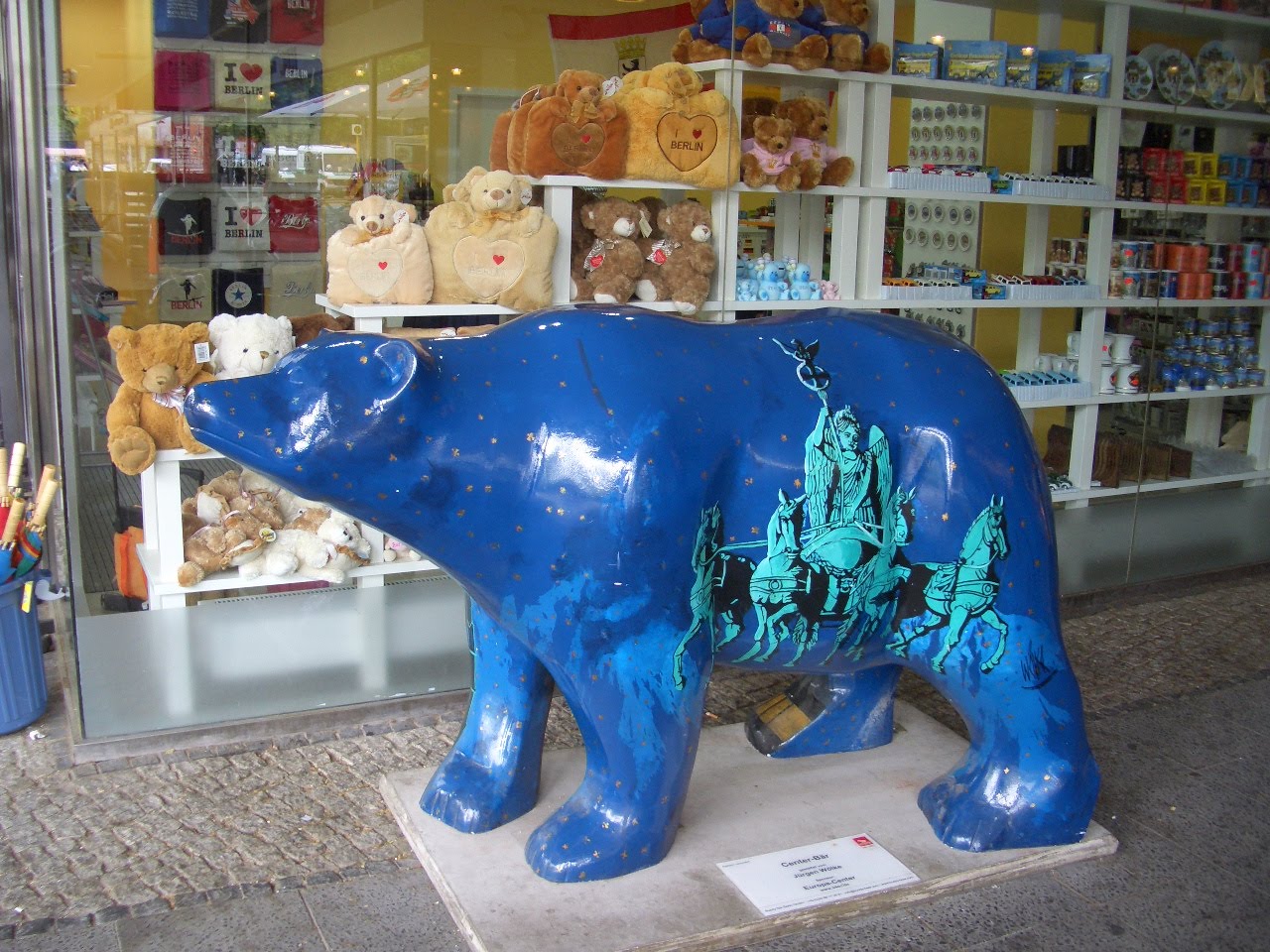
On a lighter note, Berlin's official symbol is the bear and statues like this one are all over the city, sporting creative decorations. This one shows the chariot statue on top of the Brandenburg Gate.

Back to Berlin

I'm back in Berlin, nine years after I first visited the city as a RIAS/RTDNF fellow. The program promotes understanding between German and American journalists. My previous visit in June 2001 was before 9/11 and before Europe unified its currency with the Euro. It's going to be interesting to learn about the changes and prospects for the future. But first... sightseeing!
My first visit was only a decade after the fall of the Berlin wall. The Brandenburg Gate was under renovation at the time, so this was my first chance to actually see it. This, of course, is where Berliners celebrated the fall of the wall, which passed right in front of this landmark, dividing East and West. Now, the Pariser Platz on the former East German side draws a diverse collection of odd characters on a sunny Sunday afternoon. Street performers dressed as Allied troops or the Berlin bear try to earn money by posing with tourists. A peace group held a vigil. There is still a lot of construction going on, but not the frenzy of rebuilding that I noticed the last time. Although there is still a visible difference between East and West Berlin, the Germans have done a pretty good job of cosmetically erasing the line. As I'm about to learn on this trip, however, reunification still presents many challenges.

"Lost" Luggage in Berlin

After spending five weeks in South Asia, Europe feels like home because the culture is more familiar. However, I made a big mistake upon my arrival in Berlin. I followed the other passengers off the flight, only to realize there were no signs to the baggage claim. It was inside the gate and I was not allowed to go back into the secure area to get my bag. I had to report to the "lost luggage" office and then trek to a creepy container building outside the terminal and next to the control tower to wait for my "lost" bags to be found. Unfortunately, the big World Cup match between England and the USA was being played at the same time, and I had no choice but to wait for over an hour while the baggage workers enjoyed watching the game on the other side of the wall.