Thursday, February 24, 2011

What We Can Learn From "The King's Speech"

With all of the Oscar buzz about "The King's Speech," I thought I take advantage of this teaching moment to make a few important points about talent coaching for on-air news anchors and reporters, and for anyone who needs to appear in front of a camera for online video.

First, there are a lot of bad talent coaches out there. At the beginning of the movie, Prince Albert is asked to put glass marbles in his mouth by a speech therapist who fails to get results with a "one-size-fits-all" coaching exercise. Geoffrey Rush's character, Lionel Logue, takes the time to address the specific, individual issues that are holding back his royal client's communication skills.

Another disaster occurs when the prince's father, King George, tries to improve the stammering son's performance by standing over him and commanding, "Relax!" It doesn't help your performance when the person who signs your paycheck demands that you "be conversational" without any further guidance.

Of course, stammering is a serious impediment that may require treatment by an expert in speech therapy. Most people who advance to the level of professional news anchoring and reporting don't stammer. But they often need the help of a talent coach to eliminate other types of static that is interfering with their performance. Some of our most celebrated broadcasters, such as NBC's Tom Brokaw and ABC's Barbara Walters, have noticeable speech defects. Yet, they are effective communicators. On the other hand, it's possible to have perfect diction and fail to connect with the audience.

What works? Logue insists on "trust and total equality, here in the safety of my consultation room." Talent coaching takes place in a safety zone where clients can experiment with changes in their performance that they could never risk on a live program. No, I don't ask my clients to swear at the top of their lungs, but we do breathing exercises, arm flapping and a few other things to break down the phony anchor facade and encourage an authentic performance. What happens in coaching stays in coaching. Or, as Logue puts it, "with complete privacy."

In addition to teaching skills, it's also important for the talent coach to have significant experience in front of the camera. As a Shakespearean actor, Logue knew how to project the image of a king. He understood how to size up a grand stage and prepare his client to take commeand. But, at the moment when the new king faced the challenge of preparing his country for World War II, Logue's advice was simple: "Say it to me as a friend."

Just as the stammering monarch in the movie had to deal with the new technology of radio, those of us who make our living in journalism and public relations must learn to use multimedia to reach our intended audience. Whether you are a veteran or a beginner, it helps to have a talent coach to bring out your true multimedia voice.

Get started on your coaching package at http://terryanzur.com/.

A version of this post has also appeared on a highly recommended web site for news professionals: http://the247newsroom.com/.

Tuesday, February 15, 2011

Power Women in Whittier


Empowering women through multimedia journalism and public relations doesn't always mean traveling halfway around the world. The Soroptimist Club of Whittier invited me to speak at their Feb. 15 meeting, and it was a dynamic group of women in business who are passionate about improving the lives of women and girls everywhere. They were a great audience for my talk about storytelling and political reform in the Maldives and how the techniques of multimedia storytelling can be just as important for anyone with a message to send or a product to sell. Preparing for the speech gave me a chance to get acquainted with the many good works of the Soroptimists, especially in the area of combatting human trafficking around the world. When the members join hands in solidarity and recite their pledge, I have no doubt that these powerful women will make a difference.

Wednesday, January 26, 2011

The Eyes (don't) Have It

Michele Bachmann is a rising star in American politics but she made a rookie talent mistake when she delivered the Tea Party response to President Obama's State of the Union address.
Check out the video on CNN.com. Notice that Bachmann is not looking into her camera and not talking to the camera as if it were a person. I'm told that she looked at a second camera that was recording her speech for a Tea Party group, instead of the main camera that was broadcasting her live performance. Notice how the lack of eye contact makes the overall impression kind of creepy. Bottom line: Viewers will judge your credibility by your eye contact. Be sure you adjust your studio conditions to give you a comfortable line of sight with the viewers and, obviously, know which camera is on!

Friday, January 14, 2011

Best dressed for the anchor desk... and the story

A website called Styleite has come out with its list of “Best Dressed Newscasters of 2010.” Here’s the link: http://www.styleite.com/media/best-dressed-newscasters-photos/
What does it take to make their list? Wearing lots of black seems to be the calling card of MSNBC’s Rachel Maddow, CNN’s Anderson Cooper and ABC’s Diane Sawyer. The listmakers have an odd obsession with Mika Brzezinski’s shoes, despite the fact that newscasters’ feet are rarely seen on TV.
CNN’s Fredericka Whitfield is praised for a “bold piece of statement jewelry.” Since when are newscasters supposed to be making statements with their jewelry? The people who made this list don’t seem too familiar with the number-one rule for effective on-camera appearance: Notice the person, not the outfit. While I am NOT a hair and makeup teacher, I do mention appearance issues when they interfere with delivering your message on camera. Other guidelines are:

Stick to solid, bold colors.
Avoid all white or all black.
Avoid shiny fabrics, ruffles, prints and patterns.

For women:
-an open V neckline is the most flattering.
-avoid chunky jewelry that draws attention away from your face.

Good examples from the Styleite list are CNN’s Betty Nguyen and FNC’s Megyn Kelly, although Kelly’s cleavage and bare arms would be too daring for some markets or time periods. Keep in mind that these are national news presenters who may receive help with their wardrobe in the form of a consultant, a clothing allowance or freebies from garment manufacturers.

I’d like to nominate a few people that I've already mentioned on this blog. Scroll down to read about Rochelle Ritchie, the multimedia journalist who let her chemically straightened hair go "natural" and New York anchor David Ushery, who stopped wearing a tie for his weekend newscasts. I suspect that these changes made each of these presenters seem more “casual, comfortable and connected” to their respective audiences. If I were a news director, I’d experiment with a casual Friday where newscasters could dress more like their counterparts in most other American workplaces. Find out what your audience thinks.

There’s an old saying about business attire: “Dress for the job you want, not the job you have.” It also applies to on-camera talent. If your goal is to be the friend who connects with viewers on multiple media platforms, you might want to embrace “business casual.” On the other hand, when I teach in developing countries where journalists are trying to establish their credibility, standard business attire is essential for both men and women. There’s also the angle of “dressing for the story.” You wouldn’t wear a t-shirt to a White House news conference or a coat and tie to a forest fire.

Who’s on YOUR best dressed list of news anchors and reporters? Send in your nominations and we’ll publish your feedback in a future post.

Note: the original version of this post first appeared in Professor Terry's Coaching Corner on http://www.the247newsroom.com/

Wednesday, January 5, 2011

Social Media Boot Camp: Video Rules

It's time to update your social media strategy to include video!
That message was loud and clear at a Social Media Boot Camp for CEOS, presented by a Splash Media. The Dallas-based firm provides one-stop shopping for firms who want to outsource their marketing through social networks. According to presenter John Larsen, search engines favor sites with videos. "People would rather watch the internet than read the internet," he declared.
About half of the 60 business owners in the room got that "deer in the headlights" look as they realized that they will have to appear in front of a camera. The Splash social media package includes the use of a five million dollar production facility in Dallas, with the goal of producing at least one video a month for the company's website. The on-camera talent is generally the CEO of the business. "This is not the amateur hour," Larson said.

So, in theory, everyone who is marketing a product on the web is going to need a talent coach like me! If you are going to spend upwards of $60,000 a year on social media marketing, doesn't it make sense to spend just a little more to make sure you deliver a power performance in front of the camera?
The free workshop included some awesome examples of power performance and storytelling, but my favorite was this one from a company called Blendtec. Check it out on their site, http://www.willitblend.com/, or on YouTube, where it has gotten millions of hits. These guys will throw anything into a blender, including a brand new iPad!

Monday, December 27, 2010

Out of Time! Out of Breath! Out of Luck!

First, I have to say I'm a big fan of Martin Savidge. The first time I heard his voice on the air I thought it was  Bill Kurtis. They sound very much alike. Savidge can usually be counted on to deliver a polished and professional performance, as well as solid reporting. However, in this clip he violates one of my most basic rules for effective TV newscasting. Take a look. http://tinyurl.com/35j287b
Delivering a news story on live media is similar to flying an airplane. You have to be sure your cockpit is safety checked and ready to go, so that you don't crash and burn. You wouldn't want to fly with a pilot who waits until the last second to jump in front of the controls before taking off. And you don't want to get your news from someone who slides into the seat at the last minute.
Professor Terry's rule: be in the studio at least 5 minutes ahead of time. Pay attention to your audio check and test the level in your IFB. Try to get a look at yourself in a monitor to fix any appearance issues. Check the prompter distance, your chair height, and any last minute instructions from your producer if you have one. You are ready to fly!

Monday, December 13, 2010

Professor Terry's Coaching Corner

I've just started a new column for http://the247newsroom.com/, a new website by the former editor of TVspy, Tom Petner. You can check out the site for the latest news about the broadcast and online news biz, as well as my talent coaching tips. Check it out!

Monday, November 29, 2010

Going Natural

Multimedia is changing audience expectations for on-camera talent. News presenters and program hosts are in contact with the viewers/users 24/7, on the mobile phone, on the computer, or on the TV. People no longer seek out big voices announcing the news from the mountaintop. On the internet, that "old school" delivery is often presented as a parody of credible speech. Today's news consumers prefer to spend time with an intelligent friend, someone they'd like to meet for a cup of coffee at Starbucks.  As a talent coach, I teach techniques for making delivery more "real." While I'm not a hair and makeup teacher, appearance issues are part of the package. The audience wants us to look "real."

An African-American reporter for WPTV in West Palm Beach has decided to let her chemically straightened hair "go natural" during sweeps. As reported on the Maynard Institute's web site, Journal-isms http://mije.org/node/1349, she also produced a sweeps series on her transformation. Positive reaction so far has included this comment from former CBS morning anchor Rene Syler: "...our world is shaped by the images we see; young black girls need to see more women in high profile jobs sporting their natural hair." I suspect the new 'do makes Rochelle Ritchie more "real" to her viewers/users who can't afford the $9600 she claims to have spent on straightening procedures, not to mention the risk of exposure to the harsh chemicals involved in the procedure.
Here are the before and after pix; you decide.
The natural look has always been controversial. Back in the 70s, black women had a better chance of being hired if they didn't have a look that news directors (almost always white men) considered to be too "ethnic." In this case, the management of Rochelle's station actually encouraged her to be herself and share the experience with her audience. That's progress.
What we can all learn from this: in the multimedia world, the only look that is wrong is one that is fake or phony. The hair should be nothing more than a flattering and non-distracting frame for the face. I encourage on-air talent to work with their local resources to achieve this professional but approachable look. Now that we're all doing more with less, who has time to fuss with a fancy hairdo?

Wednesday, November 17, 2010

Shoptalk: A History Lesson

The parent company of the website TVNewser has announced it is buying TVSpy.com, which brings an end to a colorful sidebar in TV News history. Perhaps you could say it died with Don Fitzpatrick, the legendary consultant who founded the industry newsletter as Shoptalk, back when dinosaurs roamed the earth and people still communicated mostly by phone and fax machine. News directors in the 1980s  received their daily dose of industry gossip by fax, and copies were furtively passed around to those "in the know." Shoptalk reflected the freewheeling atmosphere of TV newsrooms in those days and included juicy speculation about affairs in and out of the newsroom. Such antics led to threats of legal action, so the site tamed down as it became a daily email "must-read" for the  masses toiling in news cubicles with all the charm and color of an insurance office. Nowadays it offers little more than a roundup of stories about TV News, as it is covered by other media. A much better site is http://www.the247newsroom.com/, edited by Tom Petner who almost managed to revive TVSpy before it slipped into irrelevance,  its "watercooler" chat board dominated by a few nobodies hurling lame insults mostly at each other. RIP Shoptalk. It was fun while it lasted.

Wednesday, November 10, 2010

Hollywood's Take on Morning TV news

One of my most important jobs as a TV news talent coach is working with morning news teams for local stations across the US. It's a giant money pot for the stations. While the late news audience is shrinking, the morning TV news audience is growing. People who still have jobs get up earlier because they may face longer commutes and are doing more with less, while trying to get the kids off to school and make it to work on time. The TV set is on in the background of all this activity, and it's often the working parent's only connection to the weather, traffic and news in the world outside until they get to the office and can log in on the computer. They want to know what happened in the world while they were asleep, what to expect from local weather and traffic, and be smart about the topics their friends and co-workers will be discussing at the water cooler. This creates a huge challenge for the people who deliver the morning news, beginning as early as 4:30 am in some markets. No matter how sleep-deprived they are, the anchors have to bring their best game to the screen from the first minute of the program; weather and traffic have to be packed with credible information, but also fun to watch. The whole cast must function as the family that the viewers want to wake up with.  

Which brings me to "Morning Glory," the latest Hollywood take on what goes on behind the scenes of a morning TV news program. After watching the trailer, the performances of Diane Keaton and Harrison Ford seem entertaining, if not terribly realistic. In the real world, there aren't many people in front of the camera who are over 50, but it's worth the price of admission to hear Harrison growl, "I won't say the word fluffy."
Their new producer, played by Rachel McAdams, seems way too perky in the trailer to be typical of the "understaffed, overworked" people who toil on the overnights. And she has the time and energy to have a boyfriend! While I respect the work of J.J. Abrams on suspenseful action flicks, the teaser for this movie comes across as a fluffier version of the classic "Broadcast News."
 I recently completed an assignment to coach an actor for a starring role a reporter and I have played a reporter or anchor in several feature films and network TV series. Anyone interested in this topic of how journalists are portrayed on the big screen should visit Joe Saltzman's excellent database on The Image of the Journalist in Popular Culture at http://www.ijpc.org/.
For more information on coaching packages for your morning news talent or for an actor playing a reporter role, visit my website at http://www.terryanzur.com/

Friday, October 29, 2010

Salute to Stan Chambers


The Radio Television News Association of Southern California is the latest organization to pay tribute to the legendary TV reporter Stan Chambers of KTLA. His career began in 1947 when there were only about 300 TVs in LA, and Stan was very generous with helping me research my screenplay on the Kathy Fiscus story, the first breaking news event covered on live TV news in 1949. Stan was one of the two live reporters on the scene for KTLA. He went on to cover virtually every significant event in Los Angeles from the Watts Riots to the Rodney King beating. Asked how he wanted to be remembered, Stan humbly said, "for being there, for being on the scene, for being part of the city." Stan officially retired in August, at the age of 86, but he is actively promoting a new CD and book at  http://stan-chambers.com/
The program included a panel with Stan surrounded by four current news executives. KNX-KFWB's Andy Ludlum correctly pointed out that Stan's longevity on the air is a feat that no longer can be duplicated. The always gracious Stan didn't offer any insight as to how today's reporters might manage to avoid a mass layoff, a nasty news director or the perception that an experienced reporter can't Twitter and Facebook as well as a younger person who might have the added benefit of looking better in HD.  Stan himself said it best, "It's the story that matters, not the reporter." Here's hoping he can inspire a whole new generation to get it first and get it right.

Monday, September 20, 2010

Making the Grade at UNDP

Terry Anzur Coaching Services has been selected for the UNDP's roster of media trainers, which means I'll be eligible to take on some new international projects over the next two years. Although I have no idea exactly where this new adventure will lead, I was excited to read this opinion piece by U2 lead singer Bono in the New York Times.
He does a pretty good job of explaining Millennium Development Goals and the role of transparency in attacking corruption around the world. Free and independent media play an essential role in making sure that funding intended to improve the lives of ordinary citizens actually reaches the people in need. I look forward to working with everyone at UNDP to realize these goals and am honored to have the opportunity.

Tuesday, September 14, 2010

Bye-Bye to the TV News Tie

For the past year or so, I've been warning my male anchor clients to get ready to lose the tie. Now, it has finally happened. The New York Times reports that KNBC news anchor David Ushery is going tie-less on his weekend broadcast as a way of attracting viewers who have drifted away to other media. The Times goes on about how this transition will be difficult for men of a certain generation. Nonsense. Casual attire now is the prevailing custom in most US businesses and TV news was slow to change, at least on the male side. It's time.Here in Los Angeles, it's not unusual to see female news readers in attire that looks more like lingerie. Even Megyn Kelly, the "it" gal of the moment on the Fox News Channel, regularly bares her arms and a lot more. Even in the heartland or the deep south, figure-flattering knit tops have become a standard alternative to a business suit for female talent. However, the sleek, contemporary look for women appears completely mismatched when paired with a man in a suit that Don Draper might wear on Mad Men.
Then there's the temperature factor. When I was hosting on the network that eventually became MSNBC, our boss Roger Ailes, preferred a meat-locker temperature in the studio. He said the freezing air helped keep the guests from falling asleep under the toasty lights, it also kept Roger comfortable in his wool suit. (His interview program aired right after the show I did with Chris Matthews on America's Talking). Female hosts like me, who even had lights pointed at our exposed legs, just had to freeze and bear it. On KTLA, Hal Fishman kept the studio so cold that my predecessor, Jan Carl, had to keep a portable heater under the desk. During my tenure on KTLA News at Ten, I'd shiver through the show until I couldn't even feel my legs anymore, and then run to my car and turn the heater up. Allowing the men to lose the multi-layer business suit means that studios can be a more tolerable atmosphere for everyone.
So, guys, get ready to take the tie off. And get to the gym ASAP. Because soon you'll be losing the jacket, too. Put on a fitted polo shirt and let us see your guns. As we move into the delivery of news on mobile multimedia platforms, people want to see someone they'd meet at Starbucks for a coffee, not a guy in a throwback business suit announcing the headlines from the mountain top.
Judging from the picture at the top of this post, Mr. Ushery could still use some advice on appearance. The black-white contrast is a bit stark and not flattering to a person of color. The business suit may be about to go the way of the dinosaur, but there are still rules for what looks good on camera. You want to keep your credibility while becoming more casual, comfortable and connected to the viewrs.
To learn how to make your talent more effective when presenting the news in multimedia, please visit my web site, http://www.terryanzur.com/, register and schedule your coaching visit today!

Monday, July 19, 2010

Body Pump Boot Camp

In addition to coaching on-camera talent, I also do some coaching at the gym. Fitness has always been a big part of my life and it comes in handy when teaching the breath control and posture required for on-camera performance. As a certified AFAA group exercise instructor, I teach strength, pilates and cardio at 24 Hour Fitness. But I wasn't quite prepared for the challenge of becoming a Les Mills Body Pump instructor. The trainers, Megan and Don, challenged us to learn the routines with perfect form -- and an insane amout of "role model" weight. The three-day boot camp tested my limits, especially because I did the training right after pulling an early morning radio news shift at KFI. I also made lots of new friends among my fellow instructors as we toughed it out together. We've passed two auditions and now only need to submit a video of an actual class so our teaching skills can be evaluated.
You may have read my earlier post (Body Pump, May 31, 2010) about the Body Pump instructors I met in Maldives. Now I have joined them as part of the worldwide Les Mills "tribe." The organization is based in New Zealand and sets the standard for barbell group strength training. A master class with their world class instructors at the IDEA convention in Los Angeles was truly inspiring. Soon, I'll be teaching Body Pump at 24 Hour Fitness in South Hills and Glendora, including one class that I'll be co-teaching with my Group X boss, Manny Ruiz. This program has taken my own fitness to a new level and I can't wait to inspire others to achieve their fitness goals.

Last Dinner in Brussels

The final night of the RIAS exchange calls for celebration with group members who become like family during the two week adventure. The very friendly restaurant owner went out of his way to congratulate me on my certificate of completing the program. And it was one last chance to sample the seasonal delicacy, albino asparagus.
But most of all, it was one last toast to the whole group. We represented different media outlets and different age groups, but each individual brought his or her own flavor to the entire RIAS experience. Whenever I urge other American broadcasters to apply for this two-week all-expense-paid adventure in Germany and Belgium, they look at me in disbelief. It sounds too good to be true. Trust me, the only "string" attached is a short essay that each participant is required to write after completing the program. And, of course, RIAS hopes that American participants will use what they have learned to do a better job of reporting on Germany and the EU.
If you are a US radio or TV broadcaster and would like to apply for a RIAS fellowship, go to this link: http://www.rtdna.org/pages/media_items/germanamerican-journalists-exchange-program546.php?id=546

Thanks Rainer!

Watching over our group of crazy Americans, every step of the way for two weeks, was the incredible Rainer Hasters. Here you see Rainer and his faithful sidekick Lisa Ziss, looking down as our boat passed under a bridge in Bruges. Rainer has been doing this with at least two different groups of Americans every year since 1993, and he has the patience of a saint. He got a little huffy once over the slow walking pace of some stragglers in our group, but mostly he brings good cheer to every challenge. One of our fellows misunderstood the time of the bus departure from Bonn and Rainer was immediately on the case, cruising the streets in a taxi until the missing Fox producer was found. (I'm not naming names, Gabe.)
Every group photo left Rainer festooned with an assortment of digital cameras, since every one of us wanted the same picture on our own camera. Although this must have been annoying, he took all the pictures we wanted. A former radio journalist, Rainer is a fountain of information about all things German. He also graciously cheered for Team USA until we were elminated from the World Cup. I congratulate him on the German team hanging in there for third place. The success of the RIAS program, which includes two groups of Germans visiting the US each year, as well as annual journalism awards, is largely thanks to the hard work, commitment and vision of our fearless leader. Thanks Rainer!

Monday, July 12, 2010

In Bruges

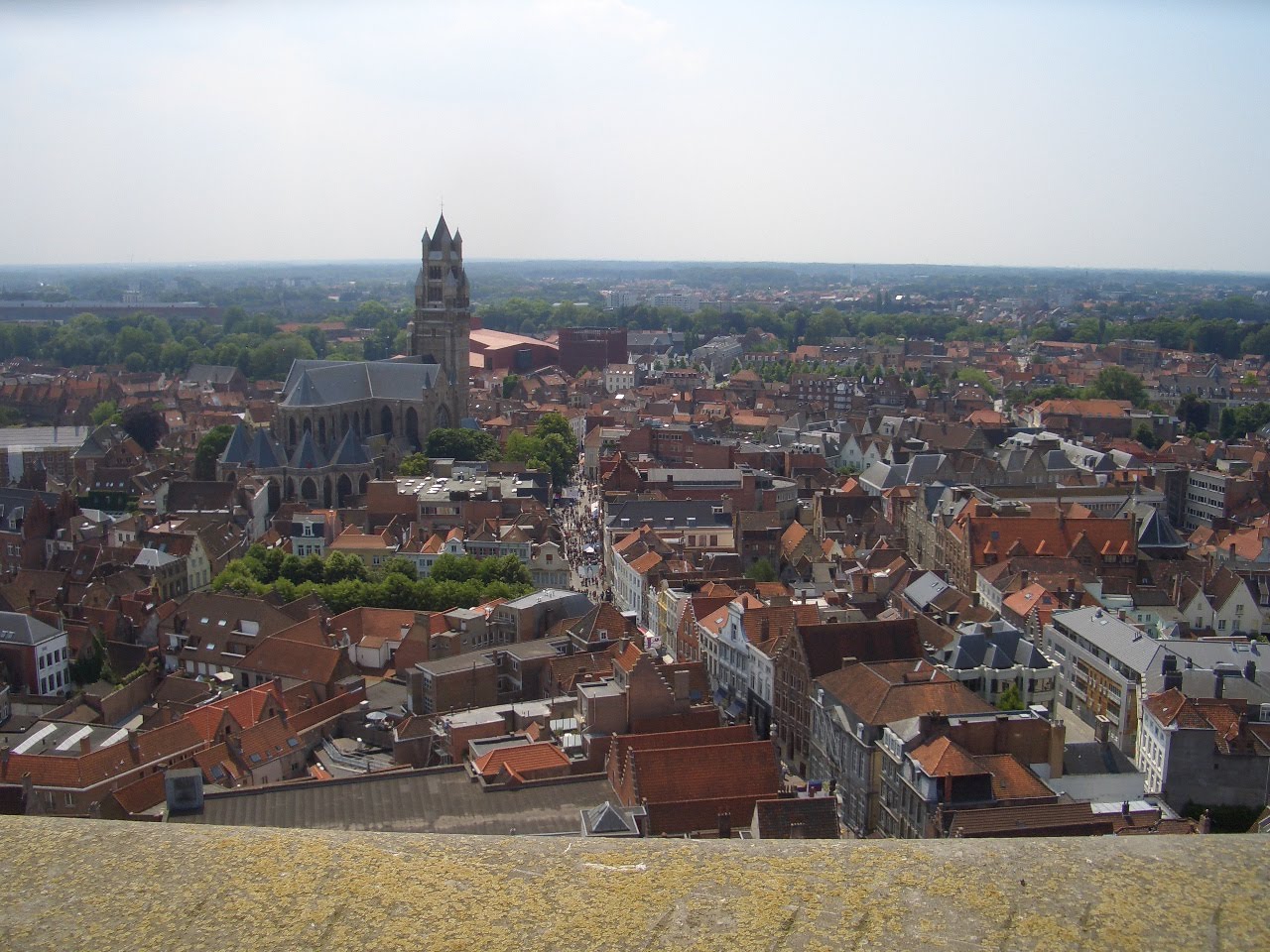
The final day of the RIAS tour was an excursion to Bruges, a charming city that is Belgium's "Venice of the North." It is a testament to the wealth of the merchant class that flourished here in the 13th through 15th centuries, bringing in such art treasures as the "White Madonna." The striking sculpture is one of the few masterpieces by Michaelangelo that can be seen outside of Italy.The best way to see Bruges is a canal boat ride, so here's a look at some of the scenery. People were taxed based on the number of windows in their building, so some of the architecture reflects the removal of windows during hard times.Every turn in the canal revealed another amazing view.

Many thanks to Rainer Hasters for allowing my son Andrew to join us on the Bruges excursion. Next stop was the charming market square for lunch.
Andrew sampled a local brew that is served in a very unusual longneck glass, and was properly fueled for the climb to the top of the Town Hall tower for a magnificent view.

Friday, July 9, 2010

Brussels Mussels and Belgian Waffles

During my last visit to Brussels with RIAS in 2001, I ventured out with former NBC correspondent of John Dancy for a plate of mussels. They were delicious, but the result was some kind of food poisoning that made me miserable for two days. This time, I opted for mussels gratinee in escargot sauce. They seemed a bit dry and chewy but this time I lived to tell the story. Did you know that the Belgians claim to have invented "French" fries? They taste amazingly different here!
Andrew, of course, sampled an authentic Belgian waffle.

Brussels' Art Nouveau

I'm a huge fan of Art Nouveau and have made the pilgrimage to see the works of Mucha in Prague and Gaudi in Barcelona. Their Belgian counterpart was Victor Horta. His house in Brussels is now a museum. Although the curved lines and features of the house are charming, the collection inside is somewhat disappointing. I had a much better time spotting examples of living Art Nouveau around the city, like this former "Old England" department store that is now a cafe.Unfortunately, some of this art has been vandalized with graffiti. Europe really needs to have a no-tolerance policy instead of treating gangster spray paint like it's some kind of modern art.My son Andrew came to Brussels for the weekend from his internship in Romania. Near the Horta museum we noticed a vampire who must have followed him from Transylvania.